CONTEXT
The AI starts from incomplete information.
Critical decisions, examples, and constraints live across meetings, docs, chat, and individual memory.
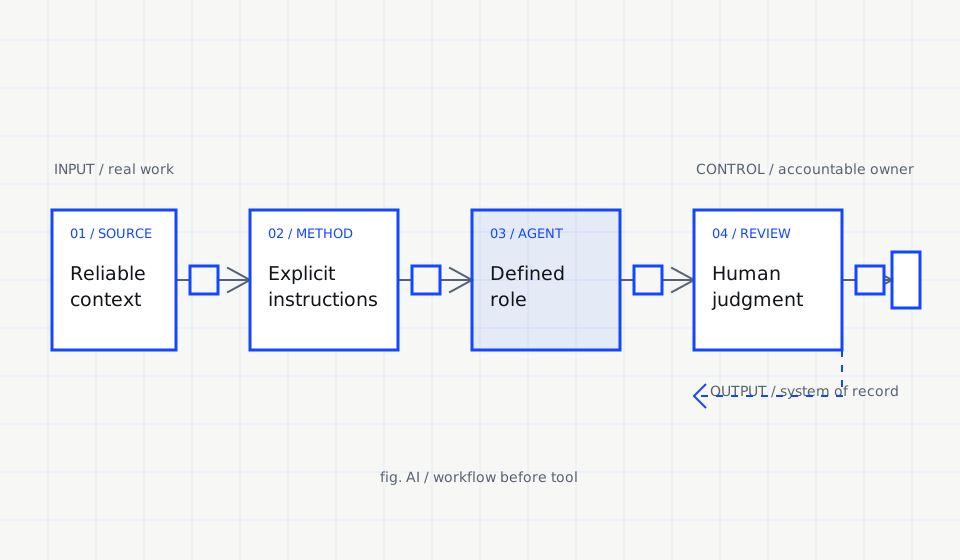
Workcraft redesigns the work around reliable context, clear AI roles, and human review, then implements the system with the people who will own it.
Teams experiment in private, prompts drift, source material stays scattered, and nobody owns the output. The demo works. The operating habit never forms.
Critical decisions, examples, and constraints live across meetings, docs, chat, and individual memory.
A prompt cannot replace the judgment, sequence, exceptions, and quality bar that experienced people use.
Teams can generate output without knowing who reviews it, where it lands, or who is accountable when it is wrong.
Tool usage rises while cycle time, margin, throughput, and quality stay unmeasured.
Workcraft makes the process explicit enough to delegate: what the AI knows, which instructions it follows, when it acts, who reviews the result, and where the approved output belongs.
Find a recurring process with a clear owner, real volume, and a visible business consequence.
Map the context, steps, decision points, exceptions, output, and review boundary.
Configure the agents, skills, automations, integrations, and workspace that move the work.
Test with real cases, measure the result, improve the method, and repeat where the pattern holds.
AI agents need explicit workflows. A role without context guesses. A process without ownership becomes another document.
Agents prepare, route, summarize, and update recurring work while people keep control of the decisions that matter.
Source material, examples, and operating instructions become shared context instead of private prompting technique.
Review rules and ownership make output easier to trust, audit, correct, and improve over time.
Workcraft combines workflow diagnosis, workspace architecture, automation, and practical AI implementation. The work continues through testing, team launch, and ownership handoff.
“Dave took our disorganized mess, with minimal direction, and delivered absolute perfection.”
“We're seeing great adoption and our team is loving the new setup.”
5.0 across 20 reviews · 50+ systems built · Notion Solutions Partner
The stack follows the workflow. Workcraft works across Notion AI and Custom Agents, Claude, Codex, ChatGPT, automation platforms, and connected business tools. The decision depends on context, permissions, triggers, output destination, and ownership.
No. Making the process explicit is part of the engagement. Workcraft interviews the people closest to the work, maps the real sequence and exceptions, and turns that operating knowledge into instructions the team can maintain.
Each workflow defines what the AI may do, which sources it may use, when a person must review the output, and who owns the final action. Higher-consequence decisions keep tighter approval boundaries.
Yes. Notion can serve as the operating layer for context, approvals, and outputs. Workcraft will improve the workspace where the workflow requires it and connect other tools where they should remain.
In 30 minutes, Dave will help you define the workflow, the missing operating pieces, and the smallest credible implementation path.