Why Companies Need Curated Context, Not More Capture
Most VC and PE firms do not have a capture problem anymore. That's largely been solved by AI.
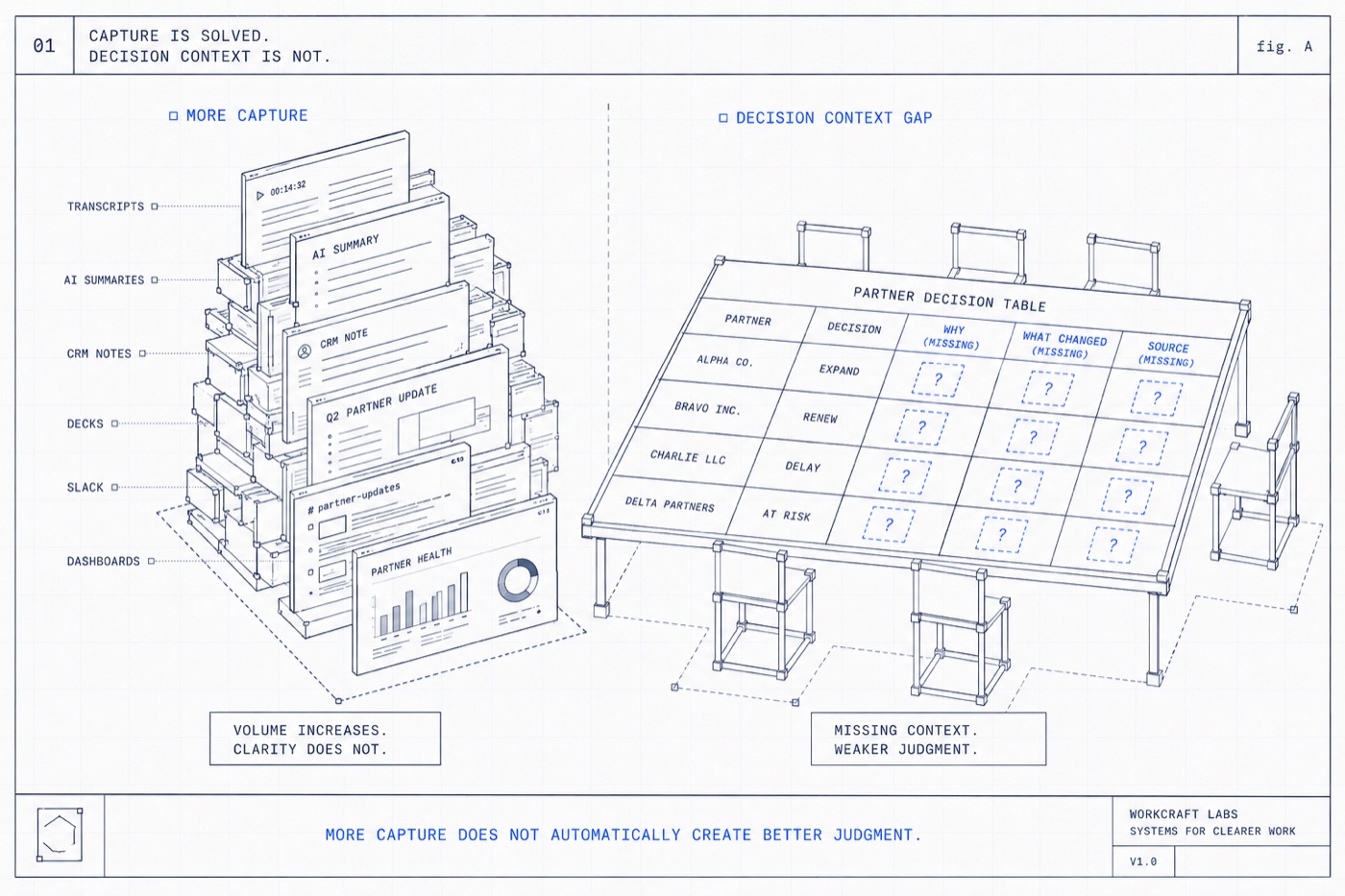
They have meeting transcripts. AI summaries. CRM notes. Portfolio company updates. Board decks. Slack threads. Investment memos. Diligence files. IC notes. LP materials. Data rooms. Dashboards.
The context exists.
The problem is that the context usually does not arrive in a form that helps a partner make a better decision.
That is the gap most firms are feeling right now. They have more raw information than ever, but the important decisions still depend on memory, scattered anecdotes, and whoever happened to be in the room when the original reasoning happened.
A partner walks into an investment committee meeting with a few strong impressions. An associate asks why the firm passed on a similar company two years ago and gets a half-answer. A portfolio review reopens a debate that was supposedly settled last quarter. An LP asks why one company was backed and another was not, and the explanation has to be reconstructed after the fact.
This is not because the firm failed to record enough.
It is because capture is not the same thing as curated context.
Raw capture preserves what happened. Curated context preserves what mattered, why it mattered, what was decided, what changed, and where the source lives if someone needs to go deeper.
That layer is what most firms are missing.
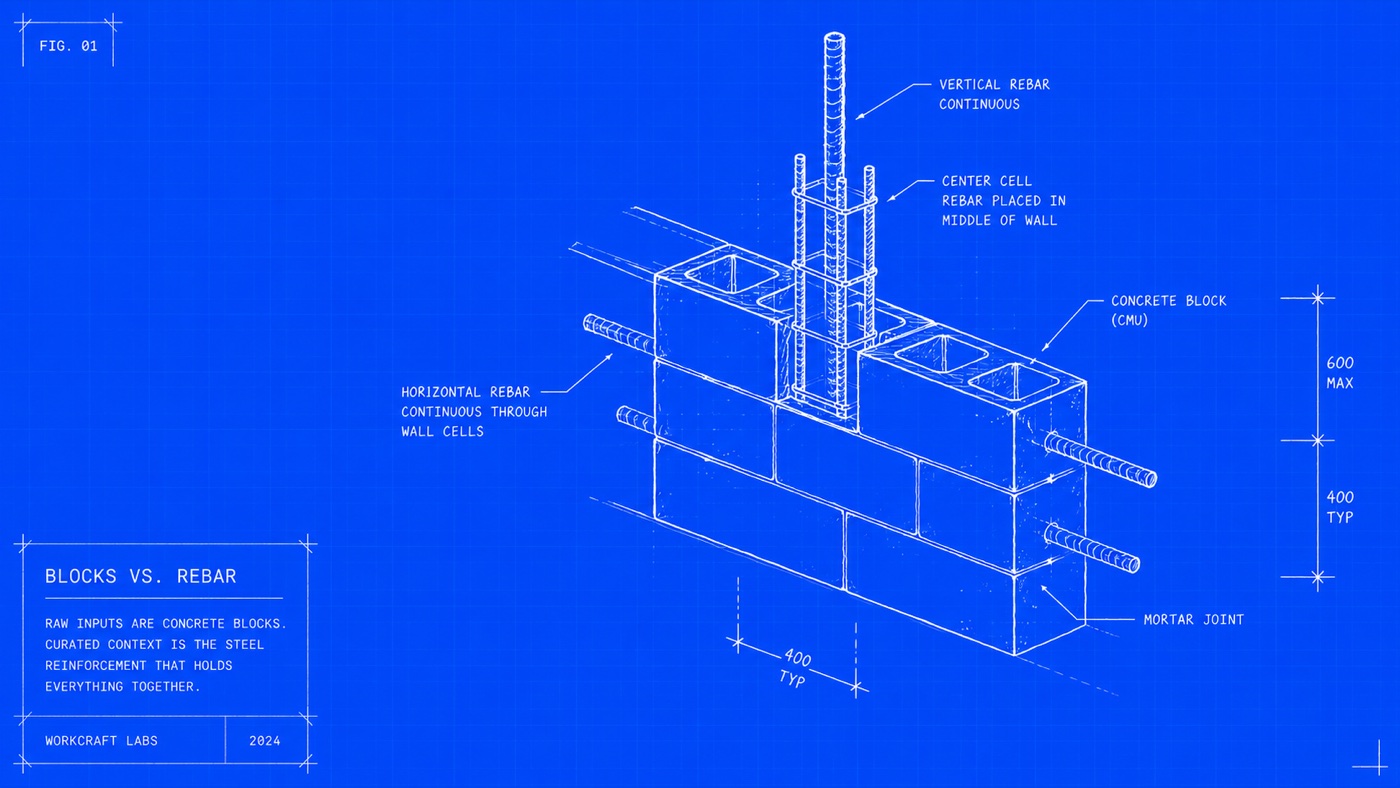
I think of it as the rebar layer.
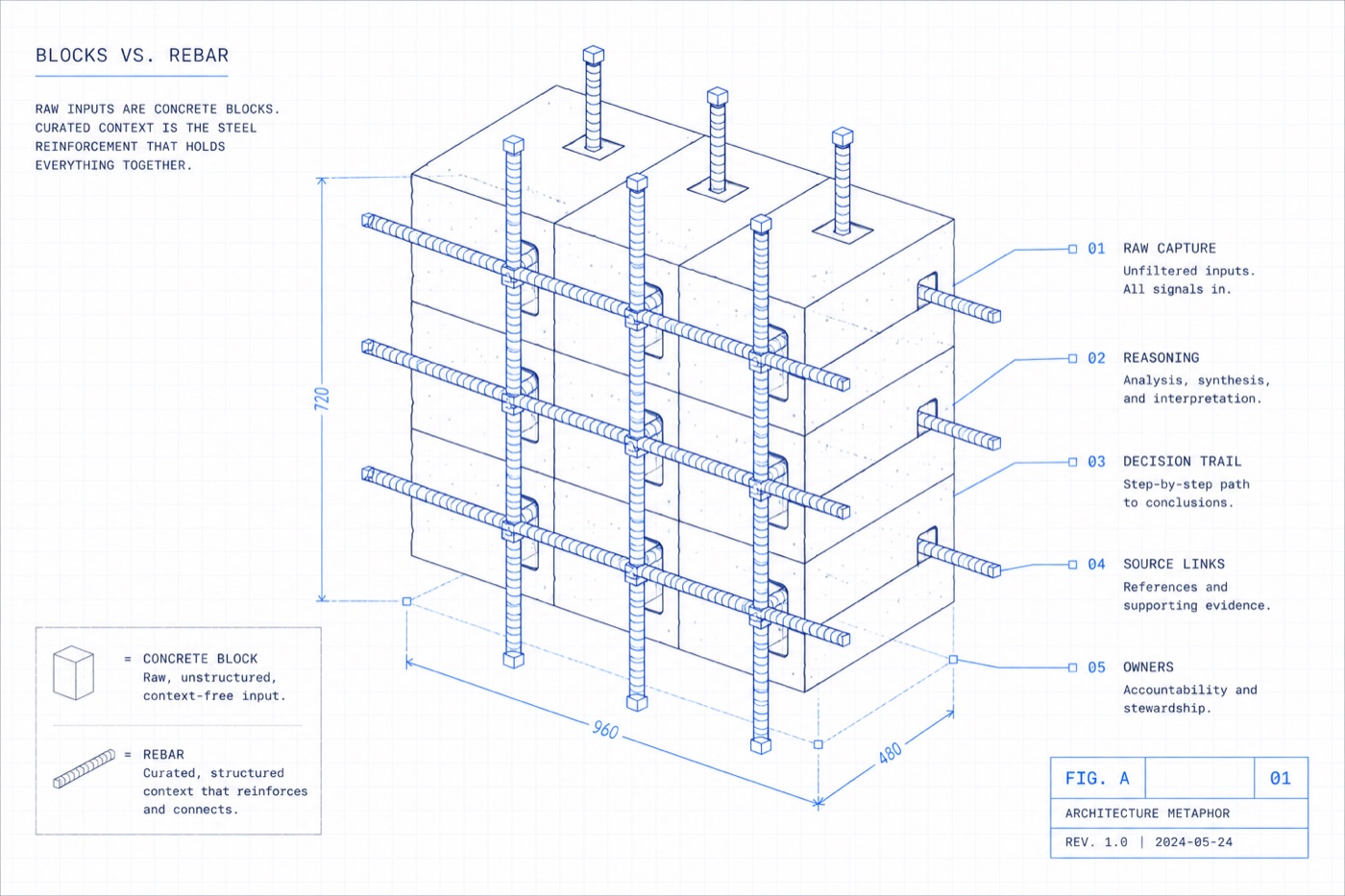
Capture gives you blocks. Context gives you structure.
A pile of concrete blocks is useful. You can build something small with it. A short wall. A shed. Maybe a simple one-story structure.
But if you are building higher, the blocks are not enough. You need reinforcement running through the structure. You need something that ties the load together, absorbs stress, and keeps the building from cracking as it gets taller.
(Bear with me, my architecture past is showing.)
That reinforcement is not the visible part. Nobody walks past a finished building and talks about the rebar. But the building depends on it.
Fund operations work the same way.
The blocks are all the raw inputs your firm already captures:
- Partner meeting transcripts
- IC notes
- Diligence calls
- Portfolio company updates
- Board decks
- CRM activity
- LP conversations
- Internal strategy discussions
- AI-generated meeting summaries
Those inputs are useful. But on their own, they do not create institutional memory. They do not tell a new team member why a decision was made. They do not make a follow-on discussion easier six months later. They do not help a partner compare today's opportunity against the reasoning behind a similar pass from a prior vintage.
They are blocks.
The rebar is the curated layer that connects those inputs to the decisions they are supposed to support.
It answers the questions people actually need later:
- What did we decide?
- Why did we decide it?
- What did we rule out?
- What would change our mind?
- Which company, deal, fund, or thesis does this affect?
- Who needs to know?
- Where is the full source if someone needs the raw detail?
That is decision-ready context. It is not just documentation. It is operating infrastructure.
Why this breaks inside organizations
Most companies make decisions and move on. Investment firms make decisions that keep compounding.
A deal decision does not disappear after the IC meeting. It shows up again in follow-on decisions, portfolio support, valuation conversations, LP reporting, exit planning, and future pattern matching.
A pass decision matters too. If the firm passed because of market size, founder dynamics, weak retention, regulatory exposure, concentration risk, or a specific thesis mismatch, that reasoning should not disappear into a transcript no one opens again.
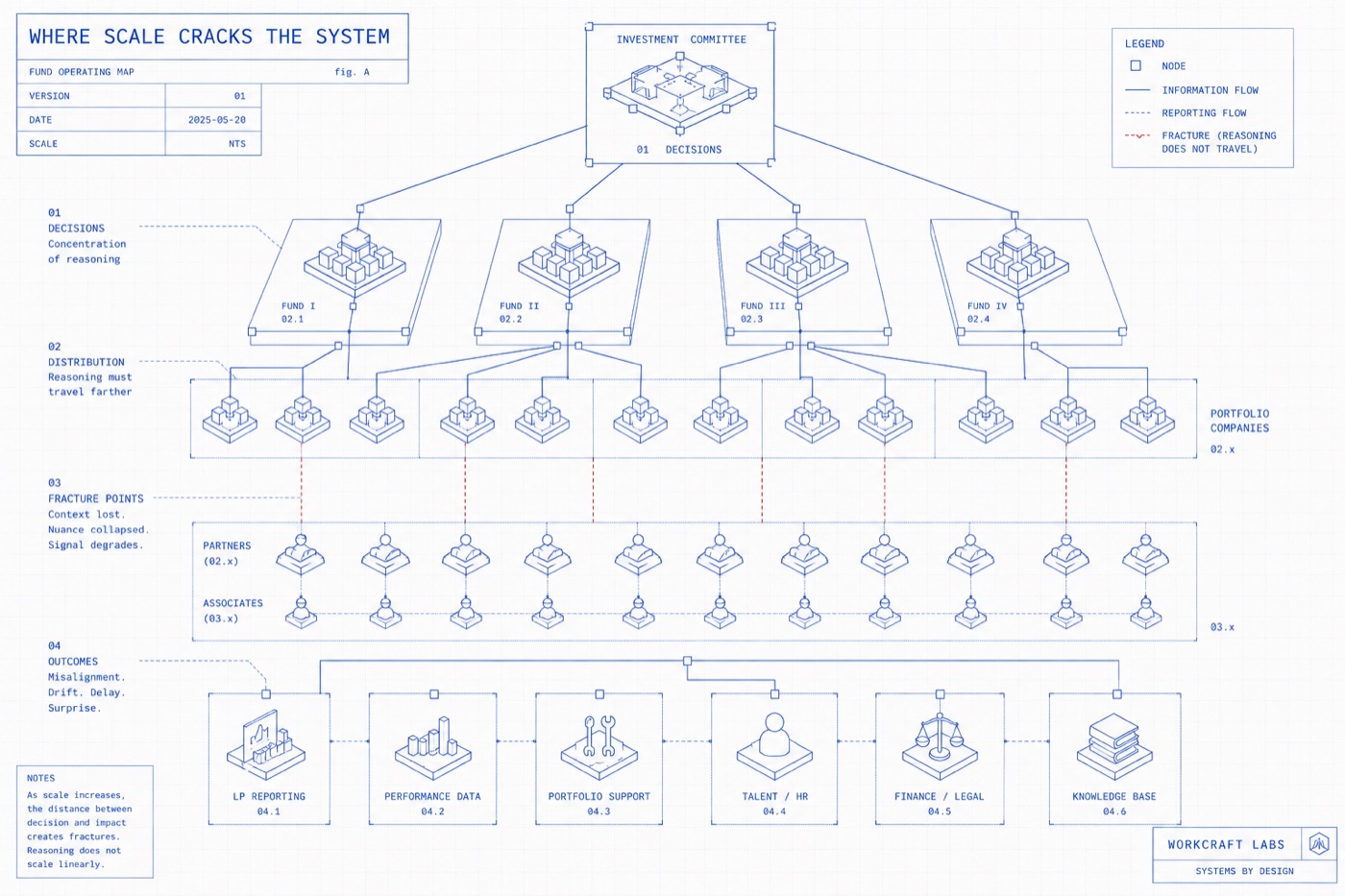
The issue gets worse as the firm scales.
At a small fund, memory can carry more of the load. A few partners are close to most decisions. Everyone knows the backstory. The firm can run like a shed: simple structure, low height, fewer stress points.
That stops working when the firm has multiple funds, more portfolio companies, a larger team, more specialized roles, and more decisions moving through the system every week.
At that point, the cost of missing context becomes visible:
- Associates reconstruct decisions from scattered notes instead of building on prior reasoning.
- Partners repeat debates because the last version was never turned into usable context.
- Portfolio support teams miss important shifts because meeting insights never reached the company page.
- New team members learn by asking around instead of reading the actual decision trail.
- LP narratives get rebuilt manually because the source reasoning was never maintained.
- Pattern matching becomes a gut feeling instead of a visible body of firm knowledge.
This is where more capture starts to make the problem worse.
Every new recording, transcript, summary, and dashboard adds more blocks. But if nothing is reinforcing the structure, the firm just has a larger pile to search through.
Search helps you find information. It does not decide what mattered.
A summary helps you skim a meeting. It does not connect that meeting to the deal page, the company page, the original thesis, the follow-on decision, and the people who need to know.
A CRM tracks activity. It does not automatically preserve judgment.
That connective work is the missing layer.
What curated context looks like in practice
Curated context is not a prettier knowledge base. It is not a folder cleanup project. It is not another dashboard.
It is a workflow that turns raw context into a reusable decision record as work happens.
A simple version starts with one recurring decision surface, such as an IC meeting, a Monday partner meeting, or a portfolio review.
After the meeting, an AI agent or structured workflow reads the transcript or notes and creates a synthesis that is actually useful later. Not a generic summary. A decision record.
For an investment discussion, that might include:
- Company or deal discussed
- Decision made or next step assigned
- Core reasoning
- Concerns raised
- Alternatives ruled out
- Conditions that would change the decision
- Owner and follow-up
- Link back to the full transcript or source notes
Then the workflow routes that synthesis to the right place.
If the discussion was about a company, it updates the company page. If it was about a deal, it updates the deal page. If it affects a thesis, it connects to the thesis page. If it creates a follow-up, it assigns the task. If the issue is material enough, it alerts the right stakeholder.
The point is not to create more notes.
The point is to make sure the reasoning lands where future work will happen.
That is the difference between capture and context.
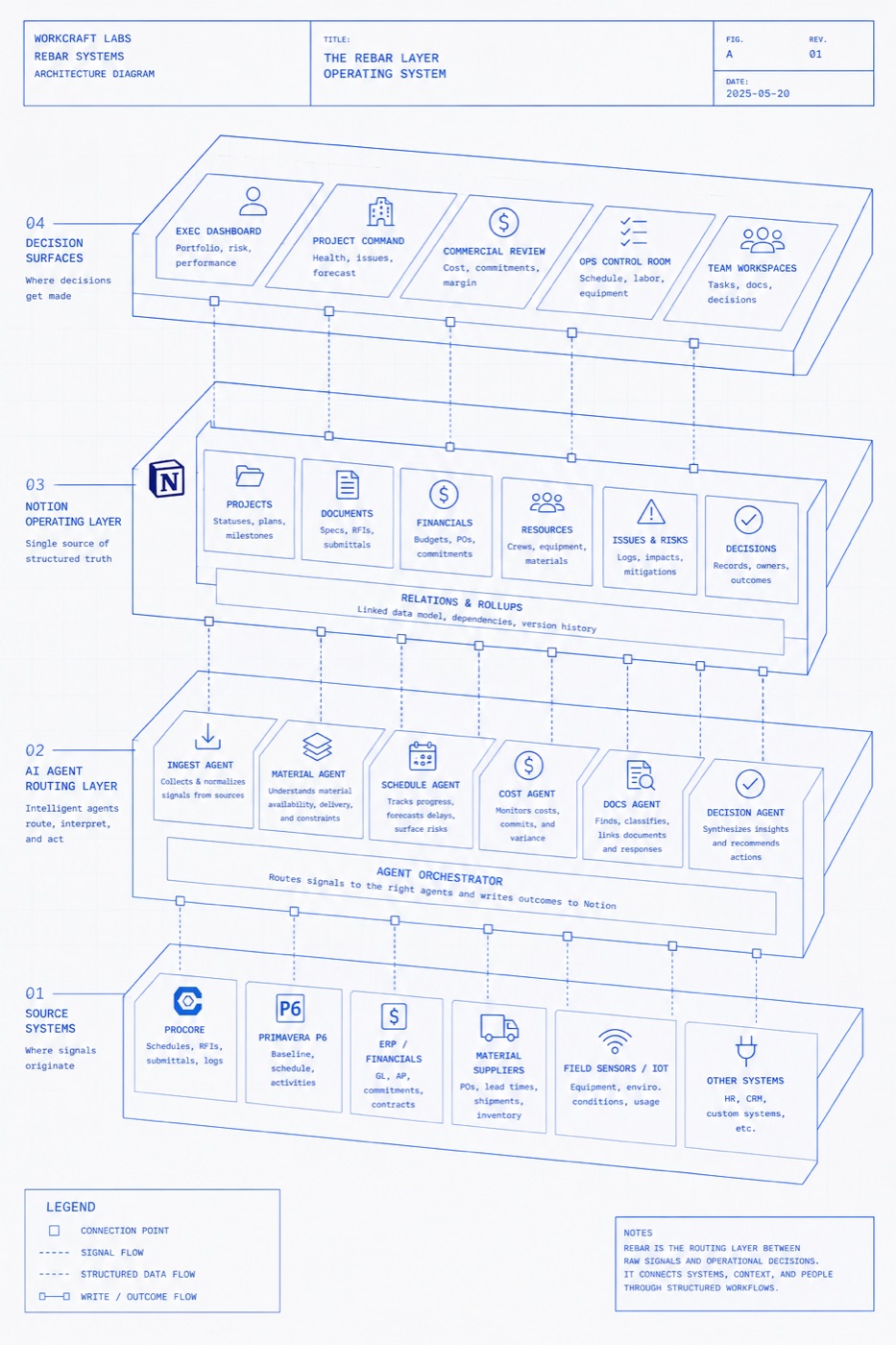
Capture says, "Here is the meeting."
Curated context says, "Here is what changed, why it changed, what we decided, who owns the next step, and where this belongs in the firm operating system."
The meeting layer is the best place to start
In venture and private equity, meetings are where the most valuable context is created and lost.
The firm already has the conversations. The reasoning is already happening. The issue is that the output of those conversations is usually too raw, too generic, or too disconnected from the rest of the workspace.
This is why meeting agents are a strong first beam of the rebar layer.
A good meeting workflow should not just summarize. It should classify, route, and preserve reasoning.
For example:
- A portfolio review mentions a revenue miss, a hiring constraint, and a possible pricing change. The agent updates the portfolio company page, flags the material risk, and links the source discussion.
- An IC conversation rules out a company because the market timing is weak but the team is strong. The agent records the pass rationale and connects it to the relevant thesis.
- A partner meeting changes the firm's view on a sector. The agent updates the thesis page and creates follow-ups for the sourcing team.
- A board deck arrives in a different format from every other portfolio company. The workflow extracts the core metrics, notes exceptions, and updates the company view without forcing the company into a rigid template.
None of this requires the agent to make the investment decision.
The agent is not there to replace judgment. It is there to make sure judgment has the right context in front of it and leaves a usable trail behind it.
The partner still decides. The system makes the reasoning visible, durable, and reusable.
Why a static knowledge base is not enough
Most internal knowledge bases decay because they depend on manual maintenance.
Someone writes the process. The process changes. Nobody updates the page. Three months later, the page is either ignored or actively misleading.
That is why many firms have a knowledge hub that technically exists but practically does not matter. People still ask the person who knows. They still search Slack. They still reconstruct from memory.
The rebar layer works differently because it updates from the work itself.
Meetings feed company and deal pages. Portfolio reports update the operating view. Decisions update the decision trail. Strategy conversations update the firm's internal roadmap. Retrospectives update the pattern library.
The hub stays useful because it is not maintained as a separate chore. It is maintained by the workflows that already produce the context.
This has real operating value:
- Consistency: teams work from the same synthesized reality instead of private notes.
- Onboarding: new associates can understand decision patterns faster.
- Continuity: reasoning does not leave every time someone changes roles.
- Accountability: the firm can explain why a decision was made without reconstructing the story.
- Speed: teams spend less time finding context and more time applying judgment.
Again, this is not about having a better archive.
It is about making the firm's own reasoning easier to use.
Why Notion and custom AI agents fit this problem
Most firms do not need another place to put information.
They need a better connective layer across the places where work already happens.
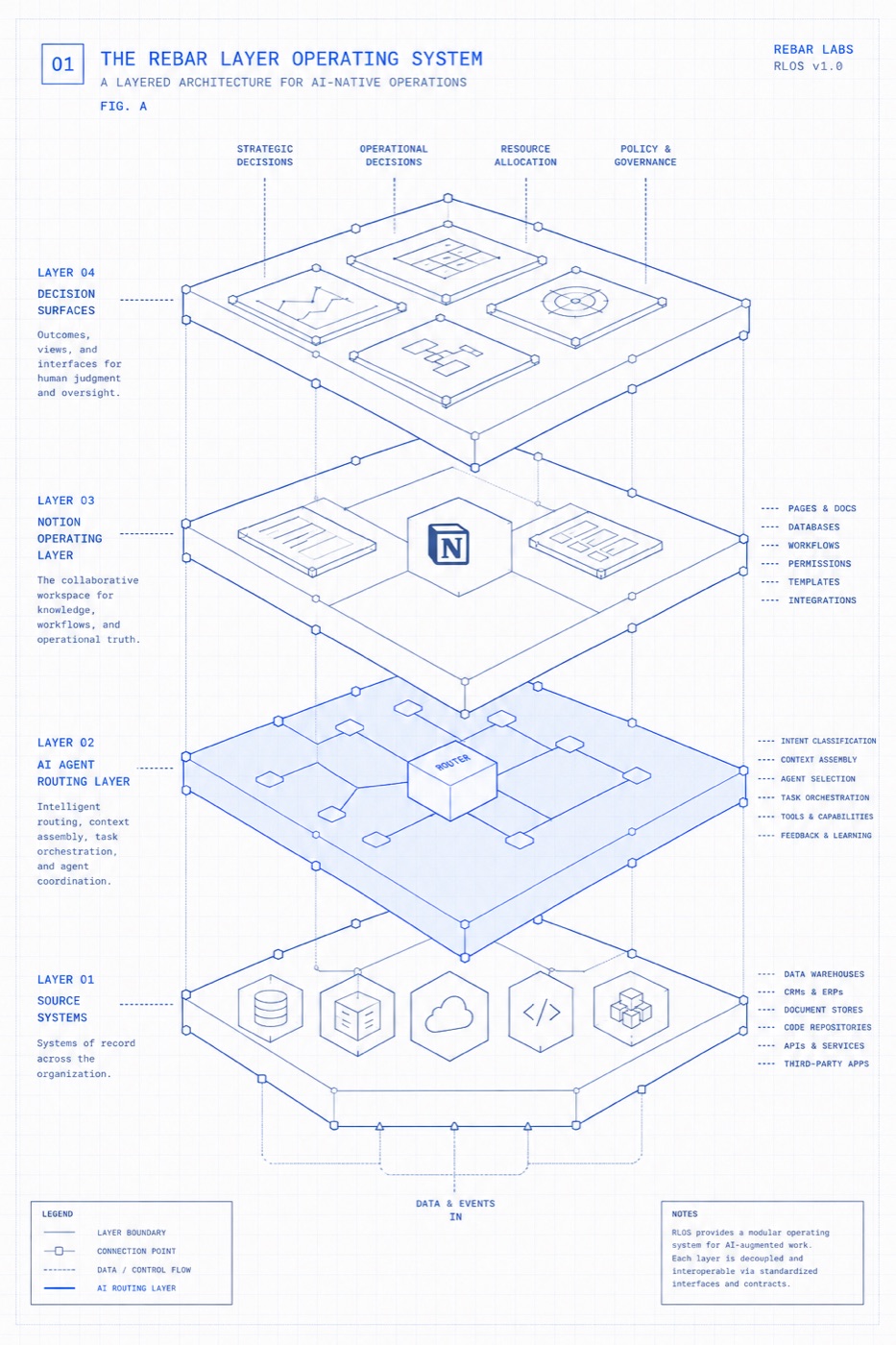
That is why Notion can be powerful for VC and PE operations when it is designed as an operating layer, not a document cabinet. A clean Notion workspace can hold companies, deals, theses, meetings, tasks, sources, decisions, and reporting views in one relational system.
But the workspace alone is not enough.
A database does not curate itself. A company page does not magically know which meeting changed the plan. A deal page does not automatically preserve why the firm passed, invested, waited, or changed conviction.
That is where custom AI agents become a real asset.
The agent reads the source context, extracts the useful signal, applies the firm's rules, and routes the output into the workspace where it belongs.
For lighter workflows, this can happen inside Notion with custom agents and structured databases. For heavier workflows, it may need Claude Code, Codex, APIs, or external automation that can pull from multiple systems, apply more complex logic, and push clean outputs back into the workspace.
The tool choice matters less than the operating pattern:
- Capture the source.
- Extract the decision-grade context.
- Route it to the right object.
- Preserve the reasoning.
- Link back to the source.
- Notify the right people only when the signal is material.
That is the system.
Start with one workflow
The mistake is trying to reinforce the whole organization at once.
Start with one decision surface.
Pick the place where important reasoning is already happening and already getting lost. For most firms, that is one of these:
- Investment committee
- Weekly partner meeting
- Portfolio review
- Follow-on decision process
- Won/lost deal review
- Quarterly portfolio reporting
Then define the output you wish existed after every session.
Keep it simple. For example:
- Decision
- Reasoning
- Risks
- Open questions
- Conditions that would change the call
- Owner
- Source link
Run that workflow for a few weeks. Do not measure it by how impressive the automation looks. Measure it by whether the next conversation is better because the last conversation left behind usable context.
If the team uses it, expand it.
If nobody uses it, the synthesis is probably too generic, routed to the wrong place, or disconnected from a real decision.
That is the test.
What you are actually building
The firms that scale well are not just better at collecting information.
They are better at preserving judgment.
They know what was decided. They know why. They know what changed. They know where the source lives. They can onboard new people into the firm's reasoning instead of forcing them to learn through osmosis.
That is what the rebar layer does.
It turns captured context into operating memory.
It gives investment decisions a structure that can carry more load as the firm grows.
And it prevents the most expensive kind of waste inside a fund: smart people repeatedly reconstructing context the firm already had.
If your VC or PE firm has transcripts, summaries, and dashboards everywhere but still makes key decisions from memory, the problem is not capture.
The problem is the missing layer between information and judgment.
That is the layer Workcraft Labs builds: Notion operating systems and custom AI workflows that turn scattered context into decision-ready context your team can actually use.
Start with one recurring decision surface. Reinforce that beam first. Then build higher.